If you drive electric in Orange County, home charging turns an excellent idea into a daily benefit. Commuters from Irvine to Anaheim, households in Mission Viejo, and condo owners along the coast are adding Level 2 crediting their homes due to the fact that it conserves time and trims energy costs when paired with the best rate plan. The work looks easy from the outdoors, a tidy wall unit and a neatly run conduit. Behind that clean finish sits a set of options that affect security, speed, and long term reliability.
I have actually invested years as an Orange County electrician walking attics in August, pulling permits with city inspectors, and fixing panels that have actually quietly taken on expansions for years. This guide folds that field experience into clear assistance so you can plan an EV battery charger installation that fits your home and your regimen, without surprises.
How quickly do you really need to charge?
Most chauffeurs in the county put in between 25 and 45 miles on the odometer each weekday. A Level 1 battery charger on a standard 120 volt outlet can include roughly 3 to 5 miles of range per hour. That pace covers light use, however it leaves little buffer for detours or weekend trips. An appropriate Level 2 charger on a 240 volt circuit alters the math. Depending upon the vehicle and battery charger setting, you acquire 20 to 45 miles of range per hour. For numerous homes, that suggests a complete overnight refill.
I see 3 patterns in regional homes:
- The short hop commuter. A Level 2 battery charger restricted to 24 to 32 amps is effective and kinder to an older panel. Plenty for a daily 30 mile round trip. The multi driver garage. 2 EVs require coordination. Either set up double battery chargers with load sharing, or run one husky circuit and stagger charge times with software. Both approaches work, but the wiring strategy must fit the automobiles you in fact own. The weekend traveler. A 40 to 48 amp charger provides headroom. You return from the mountains late, plug in, and still wake to a complete battery.
Public fast chargers make sense for journey. They do not replace home charging for life, and they do not belong in a home. DC quick charging needs commercial power, heavy equipment, and totally various permitting.
Level 2, 2 ways: plug in or hardwired
You can install a wall system that plugs into a 240 volt outlet, or you can hardwire the charger to a dedicated circuit. Both can be safe and code compliant when done right.
A 240 volt outlet, frequently a NEMA 14‑50, appeals if you like versatility. If a charger stops working in warranty, you disconnect it and swap. You can likewise use the outlet for other high draw loads during a remodel or future task. The tradeoff is mechanical. Outlets see wear. Repetitive plug insertions and the weight of some cables can loosen up connections in time. In Orange County garages that run warm, I examine these outlets more often.
A hardwired charger removes that connection point. Fewer terminations lower the possibility of heat and arcing at the receptacle. Lots of producers require hardwiring above 40 amps anyhow. If you currently know the charger brand you desire and do not plan to move it, hardwiring is clean and sturdy.
Code information matter here. Garages require GFCI protection on 125 to 250 volt receptacles, so a NEMA 14‑50 in the garage requires a GFCI breaker. Some older EVSEs also include internal ground fault security. 2 gadgets in series can trigger annoyance journeys. Many current battery chargers play nicely with GFCI breakers, but I still examine the manufacturer's notes. With a hardwired unit, the EVSE provides the required workers protection internally, so you avoid the double GFCI issue.
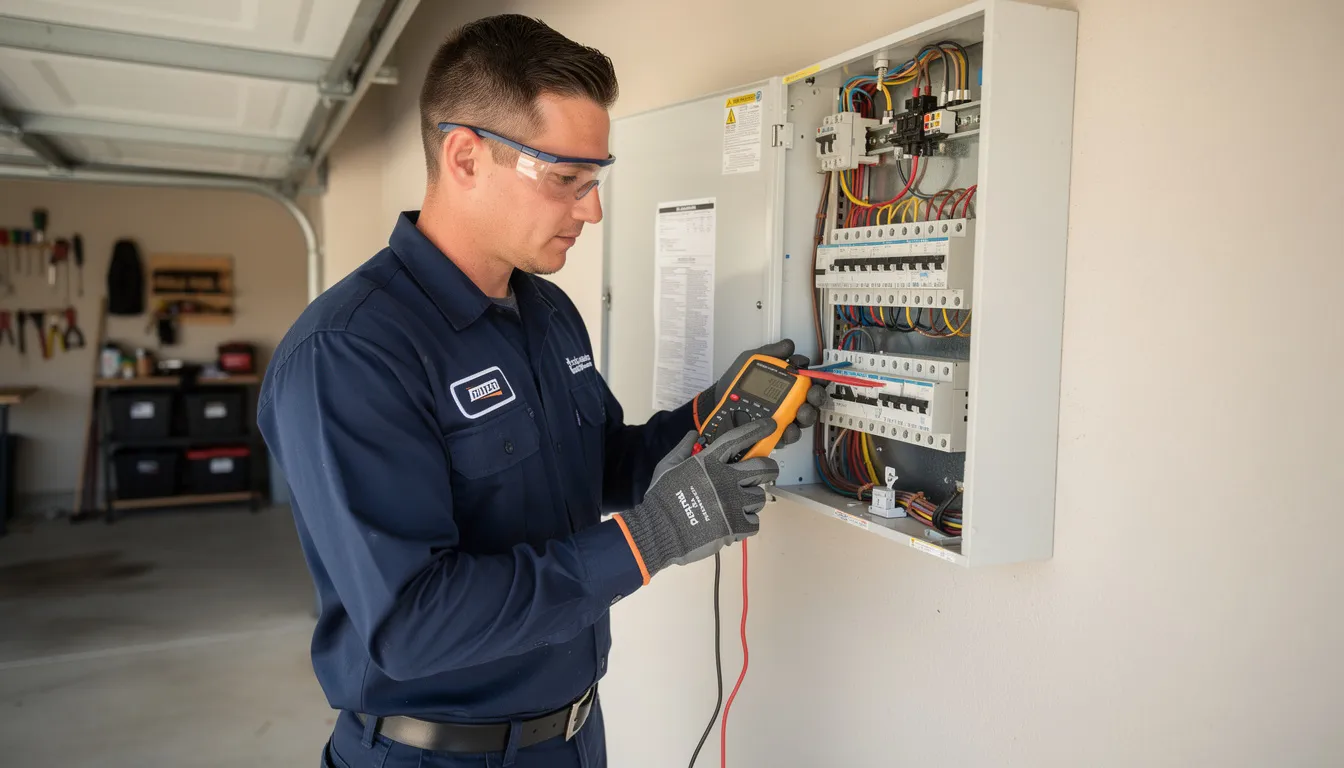
The panel is the heart of the project
Plenty of homeowners call after buying the automobile, then learn that the electrical panel is the bottleneck. The panel is just part of the story. The service size from the energy and the existing loads in the home drive what is in fact safe to add.
Here is what we look at throughout the preliminary website check out as a licensed electrician Orange County locals can rely on:
- Service and panel ranking. Lots of older homes have 100 amp service and panels. More recent homes sit at 200 amps. Either can deal with the best load estimation, however the information push the decision. Feeder and bus capacity. A 40 amp continuous EV load requires a 50 amp breaker due to the fact that of the 125 percent rule for constant loads. The panel's bus and any subpanels must enable this without overloading. Load calculation. We run a NEC Post 220 based calculation. It elements square video footage, fixed appliances, HEATING AND COOLING, and existing circuits. The math frequently shows more headroom than homeowners expect, and in some cases reveals less. Guessing here is how breakers journey at 10 pm on the first hot night. Breaker area. Some panels are full, but combinations of tandem breakers or a subpanel can clear space. Other panels do not enable tandems by listing, and we replace them rather than force a workaround.
If the panel or service requirements attention, you have choices. An electrical panel upgrade Orange County house owners choose most often is a clean 200 amp panel replacement. That can run a few thousand dollars depending upon brand name, place, and grounding corrections. A complete upgrade with a brand-new meter main and utility coordination costs more and spans a longer timeline because of energy scheduling. For tight situations, a load management gadget that throttles the charger based on real time family usage can delay a panel upgrade without sacrificing daily charging requirements. I utilize these when the math is close and the homeowner's routine is predictable.
Permits, inspectors, and doing it right the very first time
Every city in Orange County anticipates an authorization for a brand-new EV circuit. Numerous offer online over the counter reviews for simple installations. Field inspectors are fair and thorough. Bringing them a clearly significant panel, proper labeling, nicely strapped channel, and a battery charger mounted at the appropriate height makes for a fast inspection.
A normal single family home permit takes a couple of service days. Charges vary by city and job scope, frequently in the low hundreds. If trenching, a subpanel, or new service is included, include time for strategy checks and energy coordination. As an Orange County electrical contractor, we pull permits daily, and we construct lead time into the schedule so the battery charger is live when your automobile arrives.
Expect an examination, not a negotiation. Inspectors enforce the adopted code and regional changes. If something needs correction, they tell you precisely what and why, and you repair it. Basic as that.
Running the wire: surface mount, attic, or trench
No two garages look alike. Some have a tidy stud wall and a short run to the panel. Others sit behind a finished home or in a detached structure. The path figures out expense and finish.
In connected garages where the panel shares a wall, we can often install the battery charger within a few feet and run emergency medical technician on the surface in a neat vertical drop. It is quick, code compliant, and neat. If the house owner wants no noticeable conduit, and there is accessible attic area, we fish NM‑B or THHN in conduit up and over, then drop inside the wall cavity. That takes longer and may require some drywall patching.
For separated garages, we discuss a subpanel now rather than a 2nd trench later on. A subpanel near the parking areas lets you include lighting, outlets, or future clever home wiring Orange County homeowners like, without more excavation. Underground runs utilize schedule 40 or 80 PVC at a burial depth that meets code. Eighteen inches of cover is common for 240 volt branch circuits in residential lawns, though regional modifications can vary. I call out voltage drop when the range climbs. At 100 feet, even a 40 amp circuit can take advantage of upsizing conductors to keep charging effective and prevent heat.
When outdoor mounting makes sense, such as for a carport or side driveway, we utilize a battery charger noted for damp locations and follow best practices for drip loops, in usage covers on any receptacles, and UV resistant conduit. Salt air near the coast and hot inland summertimes are not kind. Materials and workmanship pay dividends.
Safety is not optional
EV charging is a constant load. That single truth drives numerous choices. The breaker and wire need to deal with 125 percent of the battery charger's nameplate current. A 40 amp battery charger https://penzu.com/p/7ad6a172c99b369d utilizes a 50 amp breaker and appropriately sized conductors. The circuit needs to be dedicated to the charger. All terminations should be torqued to manufacturer specs, and the panel labeling must reveal the circuit clearly.
Garages and outside receptacles require GFCI security. Hardwired EVSEs include workers protection by listing, so you do not include a separate GFCI in series. Bonding and grounding need to be right. I often discover old panels with floating neutrals or missing water pipe bonds. We fix those while we are on website. They are not optional details. They are the foundation of a safe system.
Finally, consider cord management. Tripping hazards in a garage are real. Mount the holster where it keeps the cable off the floor and far from racks and cars and truck doors. Little choices like this prevent damage to the coupler and keep relative safe.
The expense conversation, with realistic ranges
Prices differ by house, distance, and panel capability, however patterns repeat enough to provide sincere varieties in Orange County.
A straightforward Level 2 battery charger installation within a couple of feet of a modern-day panel usually lands between 800 and 1,500 dollars for labor, products, and permit. If we need to fish through completed walls or stumble upon an attic with a longer drop, anticipate 1,500 to 2,500 dollars. Trenching to a removed garage or adding a small subpanel pushes to 2,500 to 4,500 dollars or more depending upon range and surface restoration.
A panel replacement Orange County property owners typically ask for when area is tight varieties from about 2,000 to 4,500 dollars, affected by brand, meter area, grounding updates, and whether we satisfy existing working clearances. A full service upgrade collaborated with the utility can range from 3,000 to 7,500 dollars or higher in complex settings.
Permits and examinations typically fall in the 150 to 400 dollar range for simple installs, with higher costs for trenching or service upgrades. None of these numbers are promises, just difficult made estimate to frame expectations.
Saving money with timing and rates
The fastest way to cut fueling expenses is to enlist in a time of usage rate strategy. Southern California Edison uses several TOU alternatives that favor overnight charging. The spread between peak and off peak rates can be considerable. If your car or battery charger consists of scheduling, set it to start after the off peak window starts. Homes with rooftop solar frequently take advantage of midday charging if the cars and truck is home while the panels are working. The ideal choice depends on your rate strategy, solar production, and driving schedule.
Rebates and rewards alter with spending plans. Energies, air quality districts, and state programs often provide refunds for the battery charger or the installation. Federal tax credits might use based upon place and earnings. Given that 2023, the federal property EV charging credit is restricted to particular census tracts. Homeowners in certifying locations can declare a portion of the task cost approximately a cap. The most basic approach is to examine existing energy pages, the California Energy Commission's listings, and the IRS guidelines before you purchase devices. A knowledgeable residential electrician Orange County homeowners trust can point you in the best instructions, but your tax expert must make the last call.
What to anticipate on installation day
- A fast walkthrough to validate locations, panel area, and any modifications considering that the estimate Panel work initially, including labeling, torque checks, and breaker installation Routing the circuit by the agreed path, with holes bored or avenue mounted as needed Mounting and commissioning the charger, verifying Wi‑Fi or app functions if applicable A practical test under load and a neat clean-up, followed by scheduling the inspection if not same day
For emergency situation requires, like a tripping primary breaker after a DIY effort or a melted receptacle, call a 24 hr electrical expert Orange County residents can reach quickly. Charging gear draws severe present. If something looks or smells wrong, do not keep screening it.
Brand choices that age well
I prevent brand name evangelism, but I do try to find a couple of consistent qualities in an electric car battery charger Orange County property owners will cope with for many years. A long, flexible charging cable television handles parking variations. A robust holster keeps the connector off the floor. A system with trusted load sharing assists in 2 EV homes without requiring 2 complete circuits. Firmware that updates silently in the background, not at 7 pm when you need to plug in, matters more than marketing.
If the automobile brand name provides a charger, that can be an easy path. Third party chargers typically supply better app functions and open standards. In any case, I check listings, scores, and service warranty terms. Chargers should bring a UL or ETL listing. Be wary of deal systems without an acknowledged safety mark.
Special cases: condos, townhouses, and HOAs
Shared parking and governed communities include layers, not obstructions. I have actually completed tasks in Aliso Viejo, Irvine, and Anaheim where the space sits under a condo or along a typical driveway. The path is straightforward with the best plan.
Start with HOA approval. They will request an illustration, devices specs, color samples for avenue, and evidence of insurance coverage from the Orange County electrical contractor you work with. If the meter is remote, we route from your panel or meter, not from typical area panels unless the HOA embraces an official billing option. Load management systems assist when numerous citizens want battery chargers on one home meter. In shared garages, we install in lockable enclosures and use cord management to keep aisles clear.
Permitting is similar when it comes to single household homes, though inspectors look thoroughly at fire walls, penetrations, and labeling in shared areas. Ground fault security and proper assistances are an offered. A tidy submeter or kWh counter is a simple way for the HOA to track expenses to the property owner if they enable connection to a neighborhood panel.
Detached garages and long runs
Long drives and back lot garages are a reality of life in older Orange County areas. When the run exceeds 75 to 100 feet, I check voltage drop thoroughly. Upsizing conductors from 6 AWG copper to 4 AWG copper, for example, can keep the battery charger operating within spec and run cooler. It costs a bit more up front and returns that expense in performance and dependability. For long trenches, we plan the path to avoid tree roots and watering, and we mark the path for future recommendation. A small subpanel in the detached structure makes good sense usually. It sets the stage for outdoor lighting Orange County homeowners add later on, garden outlets, or a future shed circuit.
Common setup obstacles and field checked fixes
- Full panels with no breaker space. A slimline subpanel or a panel replacement. I prevent non noted tandem breakers that break panel labeling. It is unworthy the risk. Older services that droop throughout a/c season. A load management device that clips the EV load when the a/c unit begins. It keeps the lights on and the cars and truck charged by morning. GFCI journeys on brand-new 14‑50 receptacles. Verify the EVSE firmware and manufacturer's assistance, tighten up all terminations to spec, and verify grounding. If the charger supports hardwiring, consider that path in issue garages. Finished garage walls with no attic gain access to. Surface mount in emergency medical technician with mindful bends and color matched supports looks tidy and serviceable. Opening walls for a concealed run is not constantly the better choice. Distance and blockages. Change the charger area to shorten the run, or prepare a subpanel. Less bends and much shorter wire length typically deliver more worth than requiring an ideal spot.
Coordination with other home projects
If you are planning solar, a battery, or an electrical panel upgrade Orange County inspectors will see soon, schedule the EV battery charger in that mix. Integrating tasks can decrease overall expense and streamline licenses. If the roofing professionals are on website, have them stow a spare channel from the attic to the garage while they are at it. If you prepare a kitchen area remodel, save panel space for those circuits and let your electrical contractor align breaker places with the battery charger plan.
For remodels, I often tie in other small wins. Outlet installation Orange County house owners request in garages sets perfectly with the charger job, as does better lighting installation for workbenches or a quiet ceiling fan setup to stir the air in stuffy areas. When the team is already there, limited effort includes comfort.
Troubleshooting after the fact
Most EV battery charger installations in Orange County run for years without drama. When a property owner calls with an issue, the pattern informs the story. A charger that stops briefly midday and resumes later often faced a time of use schedule or a contending load. We take a look at charger settings and the automobile's own scheduling first. Breakers that journey randomly indicate loose terminations, undersized conductors, or heat accumulation. Thermal imaging during a test load finds locations quickly. Communication concerns with Wi‑Fi are almost always a weak signal in stucco garages. A small access point resolves it.
If anything ever smells hot, reveals staining, or hums, stop using it and call for Orange County electrical repair. A same day electrician Orange County homeowners trust will put eyes on it before it ends up being a larger concern. Security first.
Picking the ideal professional
Google will gladly serve pages of hits for electrician near me Orange County. Start with licensing and insurance coverage. A licensed electrician Orange County authorities recognize will list a C‑10 license number. Inquire about current EV installations in your city, not just anywhere in the state. Inspectors vary by city, and a regional electrical expert Orange County based will understand the preferences in Newport Beach versus Santa Ana.
Useful indications of a pro: they run a formal load computation, they talk through path options and expenses, they manage the permit, and they provide you a composed scope with the charger model, breaker size, and conductor type. Referrals for comparable tasks help, and pictures of tight, square conduit runs and tidy panels tell you how your project will look when it is done. Price matters, however the most inexpensive quote that skips a permit or dodges a panel concern costs more later. Economical electrician Orange County does not mean cut corners. It implies best sized scopes and truthful scheduling.
If your project is industrial, such as chargers for a little office lot or a retail area, search for a commercial electrician Orange County clients already use for service upgrades and parking area lighting. Multi space charging, signage, ADA reach varieties, and load sharing under a demand charge structure change the approach. The rules are different, and so is business case.
For emergencies, keep the variety of an emergency electrician Orange County residents can reach after hours. Chargers fail rarely, however panels and old wiring do not keep workplace hours.
Living with your charger
Once installed, keep it easy. Coil the cable neatly. Wipe down the handle once in a while. Glance at the breaker label when you plug in to remind guests and new motorists in the family what it manages. If the charger has an app, use it to set a schedule that lines up with your TOU rate and to see how much power you use each month. If you add a 2nd EV, revisit the settings so the 2 cars and trucks share the load or take turns.
When you head out of town, think about turning the charger off at the app or breaker, particularly for outside units. It is not needed, however it minimizes the possibility of a storm surprise or a curious next-door neighbor plugging in without asking.
Why a thoughtful setup pays off
A good EV battery charger installation is not fancy. It mixes into the garage, works whenever, and never ever draws attention. The value appears silently. You avoid detours to public stations, sleep while the automobile fills at the lowest rate, and keep the panel happy on the warmest nights. 10 or fifteen minutes of planning, a proper load calculation, and a path that appreciates the home's structure provide years of that simple routine.
If you are prepared to start, talk with a top rated electrical contractor Orange County house owners advise for EV battery charger setup Orange County wide, and ask for a site check out. Walk the route, appearance in the panel together, and make the couple of choices that set the job up for success. The rest is craft, permits, and a tidy surface. Then you plug in, shut the garage, and let the cars and truck look after itself.